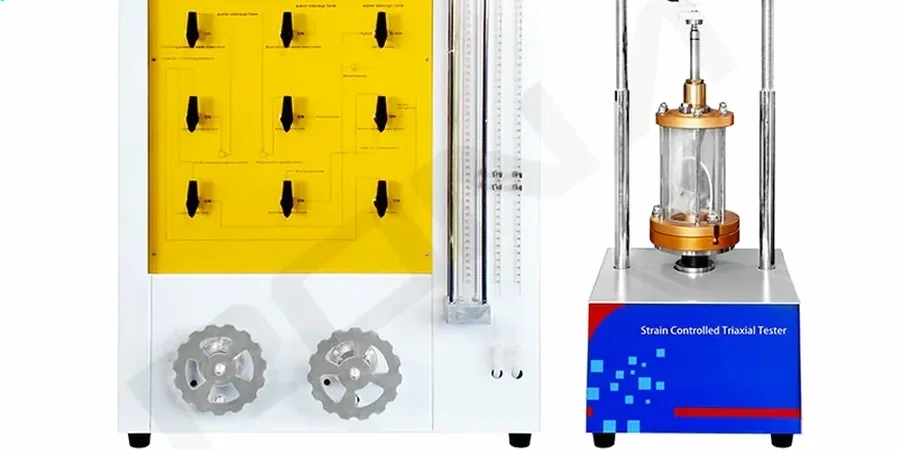
The triaxial cell sits in a temperature-controlled lab in Midtown, a self-contained pressure vessel that subjects a cylindrical soil specimen to confining pressures mimicking depths common in New York bedrock excavation. A membrane encloses the sample—often a stiff glacial till from Queens or a varved clay from the Hudson River margins—while pore pressure transducers record every shift. In our experience running these tests across Manhattan, Brooklyn, and the Bronx, the most critical phase is the saturation ramp: back pressure must exceed 400 kPa to dissolve air bubbles in dense silts without disturbing the natural structure. The axial loading frame then applies deviatoric stress at a rate controlled by ASTM D4767, and we watch the failure envelope develop on a real-time p–q diagram. CPT soundings often guide our sampling depth, especially where glacial lake deposits transition to decomposed schist, and we correlate those profiles with consolidated-undrained triaxial parameters before issuing a report.
Effective cohesion in New York’s residual soils can drop by 30% once the confining pressure exceeds the preconsolidation stress—something we only catch with a multi-stage triaxial program.