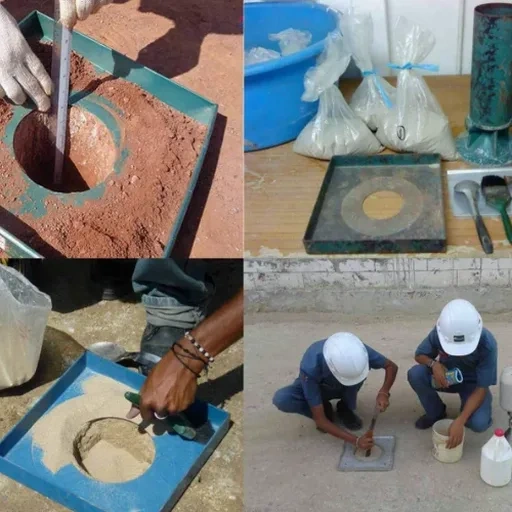
New York City's bedrock geology is famously dramatic. Manhattan schist surfaces at Midtown and dips deep below the Financial District, while glacial outwash sands and varved silts dominate much of Brooklyn and Queens. On top of that, decades of urban fill—everything from 19th-century rubble to dredged material—make the near-surface soils wildly inconsistent. When you're placing engineered fill for a foundation pad in Long Island City or compacting trench backfill along a utility cut in the Bronx, the field density test with the sand cone is the practical, direct way to verify that compaction meets the project spec. It's not glamorous, but skipping it on a deep sewer trench under the FDR Drive is the kind of decision that leads to settlement cracks and costly pavement failures two winters later. The test follows ASTM D1556, and our lab runs it alongside the nuclear gauge checks when the spec requires a direct volume measurement, especially in mixed soils where SPT drilling has already identified variable strata.
In the variable urban fill of NYC, the sand cone gives you a direct volume measurement that no nuclear gauge can dispute.